What are the advantages of structural aluminum extrusion profiles?
2026-08-17
Aluminum extrusion profiles combine the natural advantages of aluminum with highly flexible profile design. Complex cross-sections can be manufactured by extruding aluminum alloys using custom dies.
Structural aluminum extrusion profiles are aluminum profiles specifically designed for industrial and commercial applications to provide support, framing, reinforcement, or load-bearing functions.
Unlike traditional steel structures, which typically require extensive welding and machining, aluminum extrusion profiles can be produced in optimized cross-sectional shapes. Depending on specific project requirements, various profiles can be manufactured, including square tubes, rectangular tubes, channel steel, T-beams, I-beams, H-beams, angle steel, and custom hollow profiles.
What are the main advantages of structural aluminum extrusion profiles?
1. High strength-to-weight ratio
One of the biggest advantages of aluminum extrusion profiles is their relatively light weight and high structural strength. Aluminum weighs about one-third of steel, making aluminum structures easier to transport, handle, and install.
Therefore, structural aluminum extrusion profiles are particularly suitable for applications that require both weight reduction and structural performance. 2. Flexible Custom Design
Extrusion processes allow manufacturers to produce profiles with complex and customized cross-sections.
Engineers can add:
Internal cavities
Reinforcing ribs
T-slots and channels
Mounting slots
Threaded channels
Flanges
Integrated connection functions
This design flexibility helps reduce the need for additional brackets, welding, and machining.
3. Excellent Corrosion Resistance
Aluminum naturally forms a protective oxide layer on its surface, giving it excellent corrosion resistance. Surface treatments such as anodizing and powder coating further enhance its durability and appearance.
Therefore, structural aluminum profiles are suitable for both indoor and outdoor environments.
4. Easy to Process and Assemble
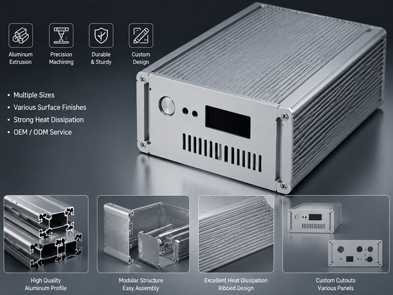
Structural aluminum profiles can be further processed according to project requirements through cutting, drilling, punching, CNC machining, bending, and welding.
For modular structures, aluminum profiles can also be assembled using mechanical fasteners, allowing for efficient installation, modification, or expansion of equipment frames and structural systems.
Which industries primarily use structural aluminum profiles?
Structural aluminum profiles are widely used across various industries.
Major applications include machine frames, automated equipment, conveyor systems, workstations, safety guards, equipment housings, buildings and infrastructure, and transportation.
Huayang Aluminum offers custom structural aluminum profile solutions, covering extrusion, cutting, surface treatment, CNC machining, drilling, punching, and other secondary processing. Customers can provide drawings, samples, or technical requirements, and we will develop profiles according to the intended application.
From industrial machinery frames and automated equipment to transportation components and structural systems, Huayang custom aluminum profiles meet a wide range of application needs.






(5).png)