1. Design Considerations and Key Points for Aluminum Profiles in Flood Barriers
Water Pressure Calculation: Select appropriate wall thicknesses and profile cross-sections based on potential water levels and anticipated pressure loads.Seal Strip Integration: Rubber seal strips are typically fitted within the grooves of the aluminum profiles to ensure watertightness and prevent water seepage.
Connection Methods:
Bolt/Nut Fastening: Durable and secure, though requiring tools for assembly.
Quick-Release Buckle Design: Enables rapid installation during emergency situations.
Corrosion Protection: Anodizing or powder coating treatments are commonly applied to enhance weather resistance and durability.
Modular Design: Facilitates easy transportation and storage; multiple units can be combined to create barriers of varying lengths or heights.
2.The Role of Aluminum Profiles in Flood Barriers
Aluminum profiles are frequently utilized in the manufacture of removable or retractable flood barriers. Their primary function is to block water flow during floods or heavy rainfall, thereby protecting buildings and urban infrastructure. In these applications, aluminum profiles typically serve as frames, mounting slots, structural supports, or sealing guides.Key functions include:
Load-Bearing and Flexural Strength: Supporting the barrier panel to maintain its structural integrity and shape under water pressure.
Sealing and Guiding: Working in conjunction with rubber seal strips to ensure a tight, watertight fit between the barrier and the ground or doorway opening.
Rapid Installation and Removal: The lightweight nature of aluminum profiles allows for easy manual handling, making them ideal for emergency response scenarios.
3.Forms of Aluminum Profile Application in Flood Barriers
(1) Frame Structures
Purpose: To serve as the skeletal framework of the barrier, providing structural support for the entire panel.
Features:
Typically constructed using T-shaped or square-section aluminum profiles.
Internal crossbeams or reinforcing ribs can be added to increase resistance against water pressure.
Can be integrated with screws or quick-release buckles to facilitate easy disassembly.
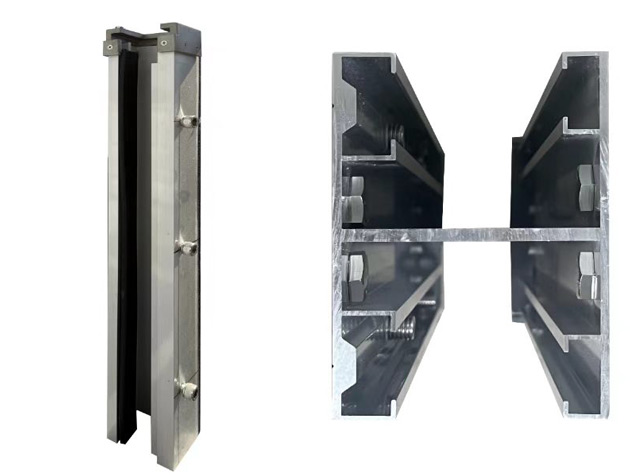
(2) Guide Rails / Mounting Slots
Purpose: To securely anchor the flood barrier to doorframes or walls.
Features:
V-shaped or U-shaped aluminum guide rails designed to receive and hold the edges of the barrier panel.
Ensures the barrier remains vertically stable and securely positioned.
The surface of the guide rails can undergo hard anodizing treatment to enhance abrasion resistance and corrosion resistance.
(3) Scalable/Modular Design
Purpose: To accommodate varying height and length requirements, adapting to different door openings and entrances.
Features:
Aluminum profiles can be prefabricated in sections of various lengths, allowing for rapid assembly.
Suitable for temporary installation scenarios, facilitating storage and transport.
4.Advantages of Aluminum Profile Applications
| Advantages | Description |
| Lightweight | Lighter than steel, making handling and installation more convenient. |
| Corrosion Resistance | Aluminum alloy exhibits strong water resistance, allowing for long-term use without rusting. |
| High Strength | Capable of withstanding flood pressure, thereby ensuring safety. |
| Machinability | Can be extruded into various profiles, facilitating the design of guide rails, frames, or reinforcing ribs. |
| Aesthetics | Can be anodized or powder-coated to match the architectural style. |