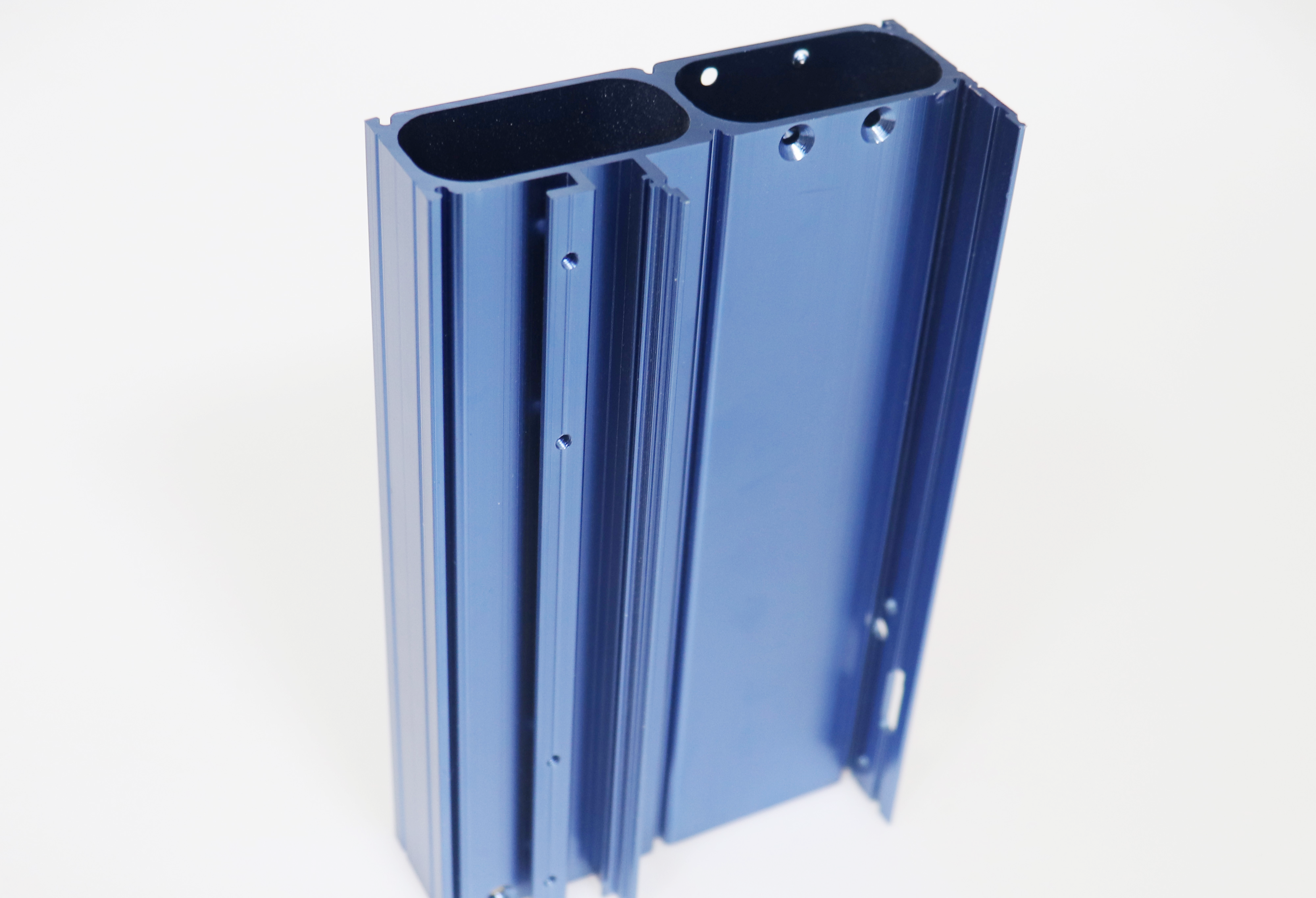
"Aluminum tube" sounds like one product, but buyers actually choose from dozens of combinations — of shape, alloy, temper and manufacturing method.

Types by Shape

Round tubing — the most common and economical form. Used for fluid and air lines, handrails, furniture, bike frames and general structures. Easy to bend and widely stocked.

Square tubing — flat faces make joining, drilling and mounting simple. The standard choice for frames, racks, machine guards, furniture and display structures.

Rectangular tubing — like square tube but with unequal sides: higher strength in one direction. Common in trailer frames, solar mounting, conveyors and architectural structures.

Oval and flat-oval tubing — used where aerodynamics or ergonomics matter: bicycle frames, fitness equipment, handrails and handles.

Custom-shaped tubing — extruded to a drawing with grooves, ribs, screw channels or multi-void sections. This is where tubing stops being a commodity: the profile itself becomes a functional part, replacing several assembled components.

Types by Manufacturing Method

Extruded tubing (porthole / structural) — a hollow billet is extruded through a porthole die, and the metal streams weld together inside the die. This is the volume method for square, rectangular and custom shapes, and for most round tubes in structural sizes. Cost-effective and strong; a faint weld seam line can be present.

Seamless extruded tubing — extruded over a mandrel from a solid billet, so the tube has no weld seam at all. Chosen for higher-pressure lines, hydraulic and pneumatic applications, and parts that will be heavily bent or flared.

Drawn tubing — extruded tube is cold-drawn through a die (and often over a mandrel) to tighten tolerances and improve the surface. This is the precision grade: thin walls, tight OD/ID control, smooth finish — used in HVAC coils, heat exchangers, medical components and telescoping assemblies.

Types by Alloy

6063 — the architectural alloy. Excellent extrudability for complex and thin-wall shapes, smooth surface that anodizes beautifully. Frames, furniture, trim, solar and display structures. Usually supplied in T5 or T6 temper.

6061 — the structural workhorse. Higher strength than 6063, good machinability and weldability. Bike frames, marine fittings, machine parts and load-bearing frames, typically T6.

Temper in One Line

The temper code after the alloy tells you the hardness: T5 (cooled and artificially aged — the standard for architectural profiles) and T6 (solution heat-treated and aged — maximum strength) cover most orders. If a drawing just says "6063," confirming T5 or T6 is the first question to ask.

How to Choose the Right Aluminum Tubing

Start with the job: carrying load → square/rectangular 6061-T6 or 6063-T5

Match the environment: outdoors or marine → anodized 6063 or  indoor and hidden → mill finish saves money.
Decide the finish early: anodizing needs 6063 for the best look; powder coating is more forgiving across alloys.

Aluminum Tubing, Made to Your Specification
At Henan Huayang Aluminum, we extrude round, square, rectangular and custom-shaped aluminum tubing to customer drawings — cut to length, drilled, punched, bent and CNC-machined in-house, anodized or powder coated, and export-packed.

Tell us the shape, alloy and application, and we will recommend the most economical type that does the job.







.png)