Aluminum profiles are ubiquitous in modern architecture, transportation, and industrial facilities, where they play a vital role in structural design. Whether used for window frames, machine guards, heat sinks, or solar panel mounting systems, these diverse products share a common manufacturing origin: they are all created by extruding aluminum ingots through a die.
The extrusion process makes this possible. Because the metal is shaped into a continuous profile with a consistent cross-section, designers can integrate multiple functions—such as structural support, internal channels, screw ports, snap-fit connections, and cooling fins—into a single component. Achieving the same functionality with steel would typically require welding or complex assembly. Thanks to the inherent advantages of aluminum—light weight, corrosion resistance, a high strength-to-weight ratio, and ease of surface finishing—aluminum profiles have become the material of choice across a wide range of industries.
Below are some of the most common areas of application:
1. Architecture and Engineering
The construction industry is the largest market for aluminum profiles and perhaps the most visible one:
Doors and Windows—Including both thermally broken and standard profiles, covering sliding, casement (inward or outward opening), and other operating systems.
Curtain Walls and Facades—Used for mullions, transoms, and framing structures in glass curtain wall systems.
Shading Systems and Louvers—Featuring airfoil-shaped blades that provide both sun shading and ventilation.
Railings, Balustrades, and Handrails.
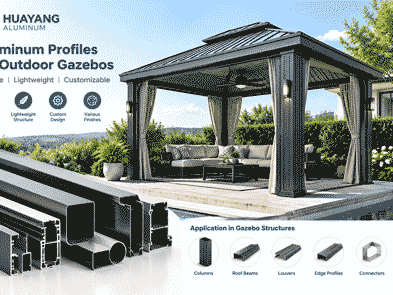
Pergolas, Pavilions, and Outdoor Structures—Comprising posts, beams, and adjustable roof louvers.
Skirting Boards, Decorative Trim, Thresholds, and Tile Edging Profiles.
Aluminum is highly favored in this sector because it does not rust and requires virtually no maintenance. Furthermore, through processes like anodizing or powder coating, architects can achieve a wide variety of surface finishes—ranging from matte black to wood-grain textures.
2. Transportation
Every kilogram of weight saved translates into fuel savings (or extended battery range), making the transportation sector an ideal application for aluminum profiles:
Automotive — Battery trays and enclosures for electric vehicles (EVs), bumper beams, roof rack rails, seat tracks, as well as decorative and structural components for buses and trucks.
Rail Transit — Wall panels, window frames, luggage racks, and interior fittings for trains and subway cars.
Marine — Masts, railings, deck hardware, and superstructure components that require resistance to saltwater corrosion.
Trailers and Truck Bodies — Side rails, flooring, and frame components.
3. Industrial Machinery and Automation
This is the domain where "T-slot aluminum profiles" truly excel and have earned a strong reputation:
Machine Frames and Bases — Modular framing systems for equipment of all scales (e.g., 2020, 3030, 4040, and larger sizes).
Assembly Lines and Workstations — Workbenches, flow racks (gravity-fed material racks), and material handling frames.
Safety Guarding and Enclosures — Machine safety fencing, protective covers, and cleanroom structures.
Conveyor Systems — Guide rails, guides, and support structures.
Robotics and Linear Motion — Linear guides, actuator housings, and gantry structures.
The core advantage here is "speed": the profiles can be bolted together using standard connectors, allowing for the assembly, modification, or expansion of frameworks without the need for welding. Furthermore, they can be easily disassembled when production lines need to be reconfigured.
4. Electronics and Electrical
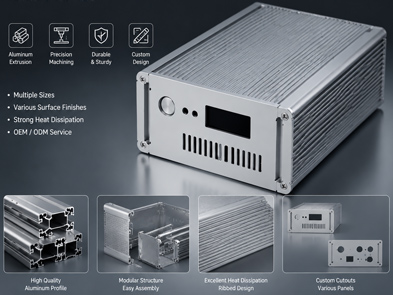
Aluminum possesses excellent thermal conductivity. Through the extrusion process, it can be shaped into cooling fins, which significantly increase the surface area available for heat dissipation:
Heat sinks — Used for LED lighting, power supplies, inverters, motor drives, and electric vehicle charging stations.
Enclosures and chassis — Cabinets for electronic equipment, instrument housings, and control boxes.
LED lighting profiles — Mounting channels and housings for LED strips and high-bay industrial lighting fixtures.
Busbars and conductive profiles — Designed for electrical applications that require high electrical conductivity.
5. Solar and Renewable Energy
Solar panel frames — Almost all photovoltaic (PV) modules feature anodized aluminum frames around their perimeter.
Mounting and racking systems — Rails, clamps, and support structures for rooftop or ground-mounted installations.
Inverter and battery enclosures — Housings for energy storage equipment that also provide heat dissipation.
In this sector, corrosion resistance is critical: solar installations are typically expected to operate outdoors for 25 years, maintenance-free.
6. Furniture and Interior Decoration
Office furniture — Table frames, partition systems, and table legs.
Kitchen and wardrobe systems — Cabinet frames, sliding door tracks, handles, and edge-trim profiles.
Display and retail — Shelving units, display frames, signage profiles, and light boxes.
Home accessories — Shower enclosures, curtain tracks, and picture frames.
Extruded profiles lend furniture a clean, precise aesthetic—a look difficult to achieve with wood or bent sheet metal—and these components arrive ready for immediate assembly.
7. Sports, Leisure, and Consumer Goods
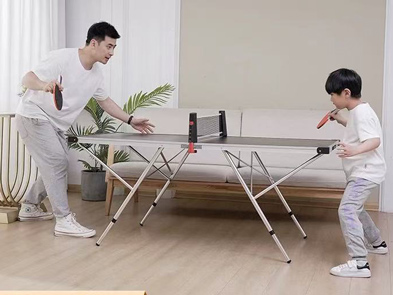
Fitness Equipment – Treadmill frames and side rails, rowing machine tracks, multi-gym stations
Outdoor Gear – Tent poles, ladders, camping furniture, bicycle components
Sim Racing and Gaming Equipment – Racing cockpits constructed from T-slot profiles
Luggage and Mobility Aids – Telescopic handles, frames, and support structures
8. Medical and Other Specialized Applications
Hospital bed frames, mobility aids, and laboratory structures – Lightweight, hygienic, and corrosion-resistant
HVAC and Refrigeration Systems – Condenser coils, cooling fins, and piping profiles
Aerospace Ground Support Equipment, Stage Construction, Scaffolding, and Work Platforms
Why is one material capable of handling such a diverse range of applications?
The common thread across these applications lies in several core properties of the material:
Lightweight yet Robust – Weighs only about one-third as much as steel; alloys such as 6061-T6 offer exceptional structural strength
Corrosion-Resistant – A naturally occurring surface oxide layer provides protection, ensuring excellent performance even in outdoor or marine environments
High Design Flexibility – Complex hollow or multi-chamber cross-sections can be extruded in a single step, allowing for component integration and reduced assembly costs
Easy to Finish and Machine – Compatible with processes like anodizing and powder coating, as well as standard mechanical operations such as cutting, drilling, stamping, and CNC machining
Fully Recyclable – The extrusion process utilizes material with extremely high efficiency, resulting in virtually no waste
Key Characteristic: Most Profiles Are Custom-Designed
It is worth noting that these applications rarely utilize generic, off-the-shelf profiles. Whether they are cooling fins for a heat sink, side walls for a battery tray, or louvers for a pergola, each profile is specifically engineered for its intended purpose.
In practice, this means the vast majority of aluminum profiles are manufactured according to customer-provided drawings: a custom die is created for the specific cross-section, followed by extrusion, surface treatment, and final processing to achieve the required dimensions.
Our factory also offers a comprehensive suite of value-added services, including anodizing, powder coating, cutting, drilling, stamping, and CNC machining, ensuring that the components you receive are fully processed and ready for immediate installation.
Please send us your drawings, required quantities, and technical specifications; we will provide a factory quote within 24 hours.